
If you like a lot of chocolate on your biscuit…
McVitie. Once a Scottish name for a Scottish biscuit, a company founded in Edinburgh and then subject to ever-more-convoluted takeovers until now, with the closure of the factory bearing that name in Tollcross, Glasgow, It’s just a label. The Turkish multinational Yildiz Holdings, rebranded as Pladis (“we promise happiness to the world with every bite”) is rationalising production, as multinationals do. And so Rich Tea and Hobnobs will no longer lend their sweet and malty aroma to the east end of Glasgow.
The McVitie name will now apply to all Pladis’s sweet snacks. I will continue, I fear to buy what was Plain Chocolate Digestives and is now Dark Chocolate. Because once you spread them with Nutella, you have a sugar rush like none other. And Nutella’s made of hazelnuts. It’s almost a fruit, and therefore healthy. Owned by Ferrero, as in being spoiled by ambassadors.
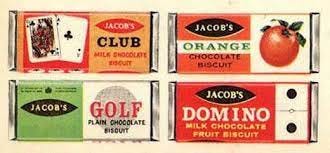
Biscuit memories can deceive. One summer a few years ago I bought and ate Jacob’s Club Orange biscuits reasonably often, for the simple and selfish reason that my wife hated – and still hates – them. Therefore I could guarantee that a secure supply of sweetmeats was lurking in the fridge when I came in from my daily grind of mild dogwalking, in need of a snacktastic sugar rush.
Memory played its part, of course. Club biscuits were as near a chocolate bar, a proper sweet, as you could get when I was a child in the 1960s, and cheaper than a Mars or a Crunchie. It had an inner foil and outer paper sleeve. You could partly unwrap it and keep the uneaten bit of bar relatively free of melting finger heat and the death-dealing germs mum said you carried on your unwashed hands. It was transitional confectionery, poised between biscuit and bar.
The Jacob’s Club has disappeared from UK shelves, rebranded as McVitie’s Club. Jacob’s is a name owned outright on these shores by Pladis, and they have decided that it spells out savoury (or unsweetened) products like cream crackers. McVitie is now to be nothing but sweetness. Except in Glasgow, where it will mean bitterness, betrayal and unemployment.
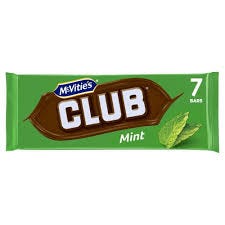
The McVitie’s Club Biscuit is…different. I always recall a Jacob’s Club as squat, brick-like, very chocolatey, very crunchy. There’s still a hint of that, but part at least of the biscuit has been taken. McVitie’s Club is thinner, single-wrapped, there’s less chocolate. And the reason? Well, corporate takeovers, the dreaded focus groups, no doubt…and the fact that Club biscuits are mired in fear, loathing, hatred, legal action, anti-French sentiment, anti- (and pro-) Irish sentiment.
It all began in Ireland, where, just prior to World War One, WR Jacobs started producing the ‘Club Milk’ biscuit from a tiny bakery in Waterford. They quickly moved to Dublin and grew. It was a classic format: two biscuits, sandwiching cocoa cream, surrounded by a thick layer of milk chocolate, wrapped in foil and then a slip wrap of paper. Within a year it was being made and marketed in the UK, from the company’s Liverpool factory. By the 1920s, the UK and Irish branches were operating separately.
The range expanded (orange, fruit, mint, plain ) and became hugely popular in the UK, until in 1970 the Irish and British divisions of Jacobs were separated. If you’re old enough you may still remember the ‘playing card’ packaging used for the original biscuit, which provided the name ‘Club’ in the first place.
If you want a lot of chocolate on your biscuit, join our club. The jingle was everywhere and there WAS a lot of chocolate on a Club. You could nibble it off leaving the biscuit layers shorn and naked. Oh, and despite many west of Scotland jokes, Orange Clubs had and have no sectarian connotations.
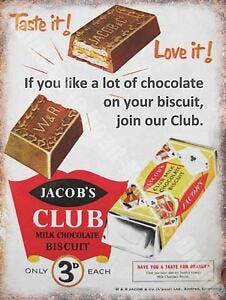
Disaster struck in the mid 1990s when French firm Danone bought both the Irish and British branches of Jacobs. They changed everything: The packaging (no foil, no paper, just cellophane) and the recipe. One biscuit, less cocoa cream, a different, thinner layer of ‘chocolate-based coating’. There was outrage. Sacre Bleu!
In 2004 things got complicated. Danone sold the UK arm of Jacobs to United Biscuits who reinstated the packaging but left the skinflint French single-biscuit recipe intact. The Irish arm was sold to the Fruitfield Group, and Jacob Fruitfield Foods was formed. Along with other distinctively Irish brands, they started marketing the original Jacob’s Milk Club, made according to its full-thickness, double-biscuit, real chocolate recipe. There are stories of legal action in Ireland to stop cheaper (and inferior) biscuits being imported. And Pladis in the UK are apparently in occasional legal ‘communication’ with Jacob Fruitfield over the use of the name on a number of other lines (like Cream Crackers, for instance; you can see how confusion could arise). Original Jacob’s Milk Club biscuits are of course readily available anywhere, thanks to the power of Amazon.
In 2008, the massive old Jacob’s factory in Tallaght, Ireland, closed, although biscuits are still being made in Portugal, Malta and the UK, sometimes, ironically, in Pladis-owned factories. Few of the Fruitfield ‘Irish identity’ products are actually made on the island.

I suppose I will still sometimes buy McVities Orange Club biscuits, and my wife will continue to hate them. She hasn’t tasted anything from my secret stash of Jacob’s Originals, delivered in a gigantic brown Amazon box and hidden carefully away, which are of course industrially-produced Proustian choccy madeleines for me: Picnics in Stonehouse Park, home of the biggest and most dangerous playground slide in the known world, or Lanarkshire. Mid-morning treats in Maxwell Park in Pollokshields, Sunday teatimes watching the mute TV (not allowed in our house on the Sabbath).
If you like a lot of chocolate on your biscuit…you may have to import your Club Milks from Ireland. But where were they actually made? Anywhere. everywhere. Not in Scotland, though, that’s for sure.

Leave a comment