
Shetland’s biggest viking fire festival is back after three years

It’s Up Helly Aa day, and here’s this week’s viking-themed newsletter – the (highly recommended) audio version (link here and with playlist at the end) contains an hour’s worth of tracks specially chosen for Up Helly Aa, including Michael Marra’s tribute to the late Thomas Fraser, fisherman and singer, plus a song from Thomas himself. Shetland artists Sheila Henderson, Inga Scott playing the galley-burning classic The Norseman’s Home, and the wondrous Spoothawk.
The lightening of the year…and yes, the approximate translation of the words ‘Up Helly Aa’ have never seemed so appropriate, or been as welcomed. Fire festivals, Shrove (Fat) Tuesday…we’ve all had enough of the darkness, the winter’s bludgeoning, especially in these northern climes. And the light is coming, is almost here, wakening you for a reasonably functional dawn, allowing some semblance of an afternoon before the blackness descends.
Scalloway’s viking stramash has been and gone, always the first, and now it’s the big one, the vast extravaganza in Lerwick, with a host of smaller, ‘country’ burnings, parades and parties to go before March. It’s 36 years since I first attended Up Helly Aa in ‘da toon’. I’ve never looked forward to it more.
This is an historic edition. Postponed for three years due to Covid, the longstanding refusal of Up Helly Aa’s male hierarchy to countenance any female participation suddenly vanished last summer. Like a red tin (McEwen’s Export) off an Ifor Williams stock trailer ramp. Actually, the tradition of squads of guizers, the fancy dress footsoldiers of the festival, travelling from hall to hall (the all-night parties are known as halls, and each of the 46 squads of guizers, 1000 people in total, must perform a skit at each) travelling in vans or trailers has been nixed too: It’s buses all the way now for safety reasons.
Indeed, the appointment of a new, central-belt nurtured Chief Inspector to the Shetland polis has seen some other health and safety impositions: all press must wear hi-viz jackets during the procession, which takes place in a blacked-out Lerwick lit only by 1000 flaming torches. The marshals for the event, who guide the marchers on the correct route, are traditionally former Jarl Squad members who, along with the current Jarl (chief) and his squad are the only ones allowed to wear viking attire. Marshals have now been told they must wear hi-viz too, which may or may not be strictly adhered to and may or may not result in some fashion issues. As one UHA veteran said: “He thinks this is like an Orange March in Glasgow.” Officers are being shipped in to deal with the mayhem that has never yet happened. And almost certainly never will.
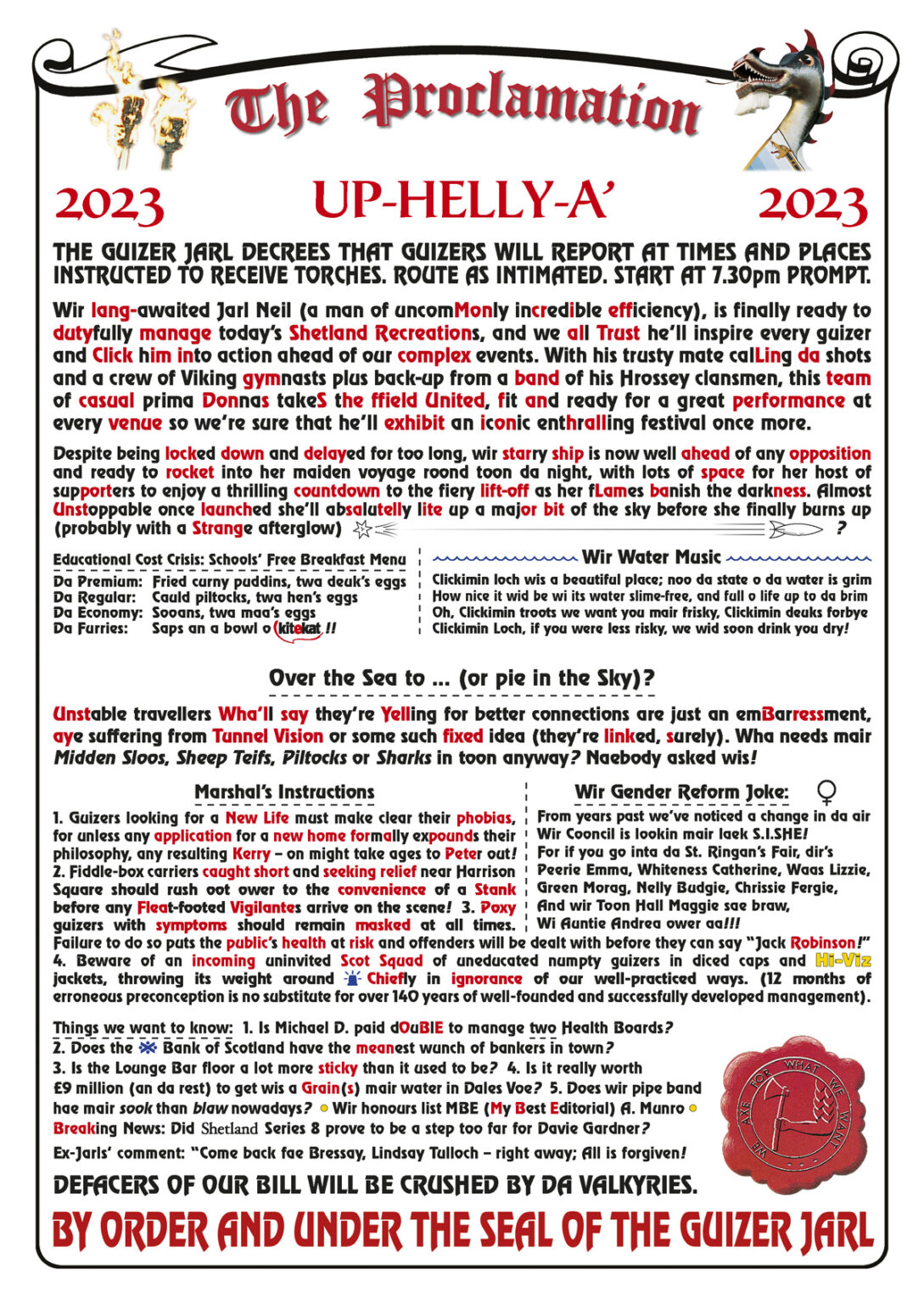
That there will be women marching is certain. Some of the most traditional squads have welcomed female family members who, by all accounts, have brought verve and imagination to planning, costumes and preparations for the ‘acts’ that have to be performed in each hall. The like-hen’s-teeth tickets (or ‘invitations’) to the various halls, with their hosts and hostesses, are traditionally divided into male and female, the biggest proportion going to women whose partners are guizing. These women are usually expected to take turns in the kitchens over the course of what can be a very long night, but it’s not clear if this too has become a gender neutral element of the festival
.
One thing is certain: the Town Hall reception for the Jarl Squad – all male, perhaps for the last time – will be presided over by a woman, as the council convener is for the first time female – Andrea Manson. Her speech will be worth listening to. The council leader is a woman, as is the chief executive.
One aspect of the event that is being policed internally is the taste, or lack of it, not tomention sheer political incorrectness of some of the squads’ attempts at satire or comedy. There has been outright racism, sexism and homophobia in the past, but the organisers seem determined to stamp this out. Drinking there will be, although the roots of Up Helly Aa as we know it are in the post World War One temperance movement and in some, indeed most halls, the consumption of alcohol is meant to be invisible.
It will be windy, although the amber warning for bad weather has been downgraded. Sparks, embers and cinders from the flaming torches will still, however, be gusting into unprepared eyes and melting expensive polyester puffer jackets, as anything up to 6000 spectators line the streets of Lerwick.
It is a winter tourist boom for the isles. I counted six camper vans yesterday, braving the 60 mph winds in pursuit of viking stimulation, wobbling from passing place to passing place, dancing sheep to sheep. Hotels are full. It’s just a pity that for many visitors, the all-night celebrations that follow the burning of the galley are inaccessible, although the intensely localised nature of the performances at these events would make much of the proceedings incomprehensible.
My favourite Up Helly Aa moments? When I was a reporter for The Shetland Times it was one of my duties to go from hall to hall, noting the performances of the squads, comparing reestit mutton soup recipes and generally having a wonderful time. You saw some…Interesting sights. But generally, what happens at Up Helly Aa be stays at Up Helly Aa. Even the now-university-professor I once came across who had gained access to a hall by masquerading as me. I remember the deluge of outraged late night phone calls after I wrote a newspaper piece making mild fun of the event’s militant traditionalism. The media for a long time were barely tolerated and sometimes disdained. Things change. Now there is a sophisticated website with technical instructions for professional videographers and a detailed press pack. Reporters are not exactly welcomed, but the international fascination for what is seen as essentially a local celebration is accepted.
In 1988 the Edinburgh punk folk band We Free Kings, which I had briefly managed, came and wangled their way into the Territorial Army Hall, where, somewhat the worse for shrooms, they were eventually bundled off stage in favour of more traditional sccordions and Boston Two Steps. One memory I do not have, but my wife does is from 1986, when she, short-haired and dressed in a white linen suit, successfully played the role of a fiddle box carrier until, four halls into the partying, she was recognised by an organiser, outed as female, ejected from the festival, and the squad she was with disciplined.

There were daft moments. The inebriated giant cornflakes packet once glimpsed staggering home in the dim light of a Lerwick morning. The Bertie Basset attempting sexual congress with an enthusiastic partner on the floor of a cloakroom.
And there was the more recent occasion when I spoke after the procession with an old colleague who explained he had marched that year in memory of his late brother, a UHA stalwart, and was now going home. No partying. Just the parting and the remembering.
I think that very moving conversation encapsulated for me the importance of Up Helly Aa in this community, as a family tradition, as a piece of ritual theatre that enables those involved not just to have a party, not just to set fire to a galley in front of thousands of folk, but to remember the past and look forward to the future in a place and with people they love.
At the last Up Helly before lockdown, I was commentating for the live streaming of the processions, and a message popped up from Ron Mathewson in London, recalling his time as fiddle box carrier and musician at the festival as a boy. It was a thrill to read that as Ron was a bit of a hero. One of the most talented of all Shetland musicians, he became a jazz bassist of international stature, a resident with the Ronnie Scott band, with Tubby Hayes and playing on countless albums including with Joan Armatrading. Enigmatic and reclusive, it was wonderful to hear from him. Less than a year later he was dead of Covid.
The days are getting longer, the light stronger
Then let us all in harmony
Give honour to the brave.
The noble, hardy, northern men
Who ruled the stormy wave.
And women. And those who have yet to decide.
Listen to the audioletter with music on Mixcloud here
Seasons are Changing — Blueflint
The Norseman’s Home — Inga Scott
Ae Fond Kiss — Steve Hamilton
Shake some Action — Flamin’ Groovies
19 — Air in the Lungs
Tropic Morning News — The National
Radio — Margo Price, Sharon Van Etten
Home Again — Lucy Dacus
Colours — Vivien Scotson
Love Conquers All — Aoife O’Donovan
16th Avenue — Lacy J Dalton
In My Own Dream — Karen Dalton
Cool Blue Stole My Heart — Joan Armatrading
Thomas Fraser — Michael Marra
Winter Winds Blowing — Thomas Fraser
Walking Through Fire — Sheila Henderson
Sweet Talk — Spoothawk
The Norseman’s Home — Inga Scott

Leave a comment