
When God and guitars were all that mattered
“Hallo, and welcome to a rather different audioletter, or Beatcroft Social, or self-indulgent trawl through my musical antecedents. I’m not going to introduce each track individually on air, so to speak (or not). The longish article below partly explains where this comes from and why I chose the various songs, a few of which will be extremely obscure to some ears. These are largely tracks from old friends, some of whom became estranged, often for good reasons, others who still wave as we pass each other online, in our invalid carriages or brandishing our bus passes. I hope you enjoy the selection, or at least find the story interesting.”
Listen to the playlist (with introduction) on 60 North Radio on Friday, 7-9, or preview it on Mixcloud by clicking here:
https://www.mixcloud.com/tom-morton2/burning-down-the-mission/
Graham Kendrick — Footsteps on the Sea
Billl Mason Band — Billy and the Rotas
Caedmon — Ten Maidens Fair
Ricky Ross — Good Evening Philadelphia
David Heavenor — It All Soon Passed
Brian McGlynn — Echoes of Another World
Just the Job — Fears of the Years
Talking Drums — Courage
Lies Damned Lies — High
Andy Thornton — One Less Holy
Graeme Duffin — Spain
Yvonne Lyon — Learning to Live Again
This all began with a photograph, sent to me by an old friend, the eminent saxophone and clarinet player Andy Brodie. It was taken some 40-odd years ago, and shows me with the late Malcolm Duffin, during rehearsals with the evangelical music and drama team Scotroc.
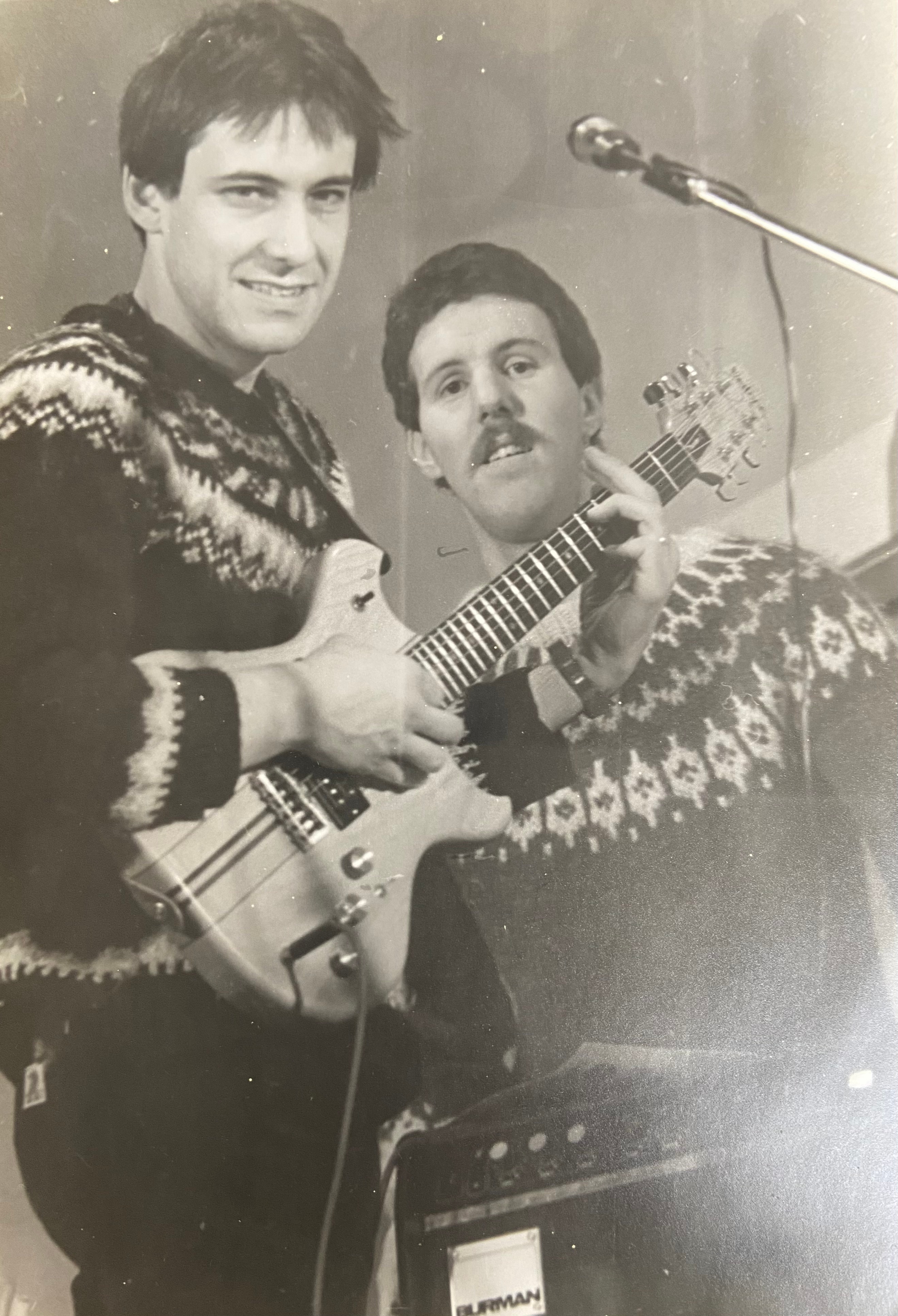
Malcolm was a terrific drummer, tragically killed very young in a motorcycle crash. With his brothers Graeme and Stuart (guitar and bass) the Duffins made up a formidable trio of musicians, notably in the lineup for an early manifestation of the band Woza, of which more later.
Anyway, that picture took me back to the late 1970s, early 1980s. Evangelical Christianity’s flirtation with folk, pop and rock music was beginning to mature from the simple appropriation of names (Living Stones, Deep Concern, White Light, all Scottish bands) and the naive alteration of lyrics (God loves you, yeah, yeah yeah) into something more exploratory, celebratory and ambitious. Musically sophisticated Edinburgh outfits like Miracle Road, LAM and Lanarkshire’s Gospelfolk/National Debt had already paved the way for really credible musicianship to ally itself with a fairly primitive expression of faith. Andy Scarcliffe and Paul Openshaw pushed the boundaries a bit more. But there was much else still to come.
Scotroc was the brainchild of the somewhat eccentric Captain Stephen Anderson, Church of Scotland evangelist, ex-soldier, member of the landed gentry, shepherd, expert skier and instructor. He had been inspired by the example of the York-based Riding Lights theatre group’s work with St Michael Le Belfrey’s priest David Watson, and recruited me (at the time a full-time singing evangelist with British Youth For Christ and the Scripture Union) to help put the project together. Malcolm had been touring in Europe with the Youth For Christ missionary rock band Oasis (not that Oasis) and was keen to join, along with keyboard player and singer-songwriter Andy Brodie (his sax and clarinet skills then in abeyance). There was Jane Sidebotham and a three-strong drama element. Also a young (16, I think) bass player called Ewen Vernal.
Andy, Malcolm and myself left Scotroc fairly quickly, though the team expanded, settled into something more akin to Stephen’s vision for it, changed personnel several times and eventually, like many of the structures of rampant old-school evangelisation, dissolved.
There are many, many stories I could, and perhaps should tell about this period in my life. Some of them are, thinly disguised, in my (out of print) 1994 novel Red Guitars in Heaven (Mainstream Publishing, 1994) and a somewhat different take can be found in Stephen Anderson’s memoir Mussels At Midnight (Christian Focus Publications, 1994).
Actually, what I intended to do here was introduce the playlist of songs you can hear below, which was kicked off, as I said by the appearance of Andy’s photo and a comment on the Facebook thread in which it appeared. Eric Stephen posted some snaps from the 1980 Street Level Festival programme in Dundee, challenging folk to identify the musicians shown. Street Level was organised partly by a young Dundee youth worker named Ricky (then Richard) Ross and was an urban Scottish version of Greenbelt, the cutting-edge Christian arts festival then held in Suffolk.

There’s some chat in the online Mixcloud and 60 North show, but here’s a brief outline of why I picked these tracks. And again the history (rise, fall and dissolution into MOR worship band culture) of the 70s and 80s British and Scottish “contemporary Christian music” scene is worthy of a much more lengthy and incisive analysis. I may attempt this before my memory fades into James Last Orchestra mush.
The tracks here indicate the move from preaching to worldliness, soul-acquisition to soul-searching, dazzled spirituality to social engagement. And ambition. A desire to compete in and with the ‘worldly’ music industry, to make great art, make money and become famous.
You can choose which songs represent these various states of creation…
Graham Kendrick (who, interestingly, my fellow 60 North DJ Mike Wade played drums for) was absolutely seminal in the Key Records/Buzz Magazine Christian music scene, before he went all hands-in-the-air worshippy. His first album, Footsteps on the Sea, featured the superb guitarist Gordon Giltrap and was crucial in kindling my desperate desire to fingerpick adequately. This is the title track, re-recorded I think once Graham had sorted out his adenoidal vocals a bit.
The Bill Mason Band headlined I think the 1979 or maybe 1981 Street Level. They were the first “Christian punk” band, and tore Adelaide Place Baptist Church in Glasgow apart when they played there. Literally kicking open the door to their ‘dressing room’ (the vestry). I thought of them when I heard that Glasvegas had made a video in the now-for-hire building.
Caedmon were students from Edinburgh who made what became one of the most valuable “Christian psych-folk” records, particularly if you still have the extra 7-inch single and lyric sheet. £500 nowadays, and before the band started reissuing versions, it was more. They were friends with Fife’s David Heavenor, as was Ricky Ross, later of Deacon Blue and much else. The track here is probably my favourite of his solo work, from his first post-DB album and an inexplicable commercial failure, as the production, playing (by some seriously big names) and performances are superb. Too bleak and fierce, perhaps.
Then we have David, still making excellent music, as is Brian McGlynn, though it’s hard to track down contemporary material. This song is from the early The Vital Spark release, though , and you can hear that it’s from cassette. Apologies to all concerned, but it is a great song I think.
Truth to tell, the big names in Scotland, the best of us in early 80s, were Brian, Ricky and solo singer songwriter Steve Butler. Brian and Ricky originally formed a band called Woza with the Duffin brothers, though this shrank to a more new wave-y version with Ewen Vernal, formerly of Scotroc. Eventually, Ricky would form Dr Love with Ewen and Andy Brodie, which would become Deacon Blue.
Just the Job, meanwhile, were a Glasgow new wave band from the Iona Community end of the Christian spectrum, and much more focussed on secular gigs. An early live session for the Annie Nightingale Radio One show ( I still have it on tape somewhere; “Our new favourite band” said Annie) brought them sudden exposure and they were terrific live. Lead singer Rachel Smillie was replaced by Paul Middleton for the single Fears of the Years and a cassette called Living in the Welfare State. Social engagement was the thing. And dancing.
Talking Drums’ Charlie Irvine and Derek Clark had come from the uneasily evangelical (and hugely popular in church circles) rock band Harvest and with keyboard player Dot Irvine became the core of a band, fronted by Carole Moore who were signed to Myles Copeland’s IRS label and for a time looked extremely likely to succeed on a major stage. Steve Butler helped produce and eventually, once the band split, Charlie, Dot and Steve formed Lies Damned Lies, signed to a major label and responsible for some wonderful music. But destined, alas, to be overshadowed by others mining the same seam, such as the Blue Nile. Carol was on early Deacon Blue demos and is now a highly successful visual artist.
Andy Thornton who had been in a notable duo with John Griffiths called Stonewall Griffiths, joined Scotroc before forming Rattling the Cage with Ewen Vernal and Lorraine Mackintosh. Major record company interest came to naught, and Ewen and Lorraine joined Deacon Blue. Andy moved to England and made a number of acclaimed albums as well as working as a producer and engineer.
As for Graeme Duffin, he (along with Dave MacLachlan from Just the Job, Derek from Harvest and Talking Drums, and Norrie Craig from the Prendergast Smythe Band (!) recorded a couple of albums with one Tom Morton (one, Weimar, with the complete cast of Duffin brothers), as well as almost everyone else mentioned in this article. Then he joined Wet Wet Wet. My favourite story from that era involves a seaplane, but it’s Graeme’s to tell, really. Graeme is still touring with a version of Wet Wet Wet and recording his own excellent solo guitar pieces, as on the recent album Spain.
So much more to say. If there’s any demand, I may return to this endlessly fascinating topic. Well, it’s fascinating to me. I suppose I was just pondering the people and sounds of my past, wondering what had happened to them, to us. And thinking back to a time when religion and music mattered more than anything else, until for some of us, religion won, while for others, music and its appurtenances took its place. One or two abandoned both, or were abandoned by them. Some, like Malcolm, have left us. And for a few, that lucky few, a perfect balance between the two was found. Or that’s what they’re saying.
And there is barely a “Christian” music scene now, although black churches in England have gifted us many hugely successful artists on the soul, R&B and pop scenes, and there are many lights-lurking-under-bushels performers out there. Greenbelt is 50 this year, and to quote its online presence, “ is a festival of arts, faith and justice held annually in England …(it has) grown out of an evangelical Christian music festival.” And there you go.
Of today’s artists with at least one foot on the faith camp, my favourite is probably Inverclyde’s Yvonne Lyon, who I think is probably better than anyone from that torrid 80s period, and better too than maybe she thinks she is. Beathtakingly incisive as a songwriter. I thought I’d bring things up to date with one of her songs, from the moving album about bereavement, Held.
https://www.mixcloud.com/tom-morton2/burning-down-the-mission/

Leave a comment