
And the new Beatcrofting radio show
Originally published in the online magazine CABLE a few years ago, then on my lost Medium blog, I’ve given this a bit of a freshening up with a view to using at least some of it in the Louder than God memoir. WARNING: It’s long…
The inspiration for writing it during the Trump presidency was the story – since questioned – that Vice-President Mike Pence had been ‘converted’ after attending a Larry Norman gig. Now it seems that it was at a festival Norman may have headlined. That led me to have a think about how sci-fi premillennialist evangelical theology underpinned and appeared to underpin some policy making at the Trump White House.
The Beatcrofting radio show is over on Mixcloud here:
https://www.mixcloud.com/tom-morton2/beatcrofting-with-tom-morton-friday-6-october/
…and the playlist is at the end of this (as I say, long) piece…skip it if you insist! Quick thank-you to Douglas Small for unearthing the fact that Kathryn Moses is the vocalist on Bruce Cockburn’s Mama Just Wants to Barrelhouse all Night Long.
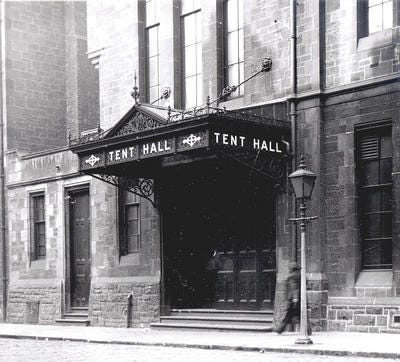
The Tent Hall, Steel Street, Glasgow, 1972. A cavernous space, smelling of mothballs, polish, sweat and antiseptic, bone-meltingly heated against the vicious winter night outside. It is packed, rammed with mostly young Scottish evangelicals from across the denominations curious to see the latest fundamentalist phenomenon from the USA.
A figure shambles on stage, very late; we’ve been sitting for hours, singing Gospel choruses. God’s Not Dead, He Is Alive. Feel Him All Over Me. We’re too innocent to hear the potential ribaldry. Ungodly weather has delayed the tour bus. There’s a guitar case, battered, and a pantomime over opening it, extracting a cheap guitar, tuning it. Its player looks like a space alien. Long, absurdly long, girlishly long white-blond hair; he’s rail-thin, plastered into tight jeans, a mad jacket with embroidered stars. We gaze in astonishment, we youth fellowship and Bible class members, we singers of Kumbayah and Oh Sinner Man.
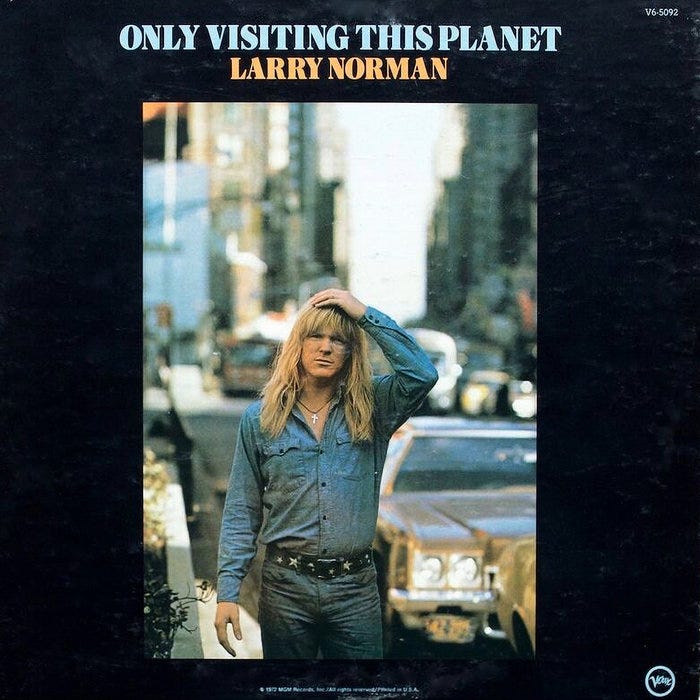
Larry Norman, the first Christian rock star, originator of the ‘one way to heaven’ sign (first finger, please, not middle) pioneer of the Jesus Movement, is among us. He has been thrust on stage while the support band Parchment prepare. The only amplification is the Tent Hall’s venerable system, and as we watch, paralysed with holy mirth, Larry acts out Chaplinesque puzzlement as to how it can be used. Eventually he clambers onto the oak pulpit, teetering dangerously on the lectern in order to get his guitar close to the microphone. An ear-shattering, distorted chord. Then a voice whose ragged, torn glory comes just the right side of squeaky:
I want the people to know that He saved my soul
But I still like to listen to the radio
They say rock’n’roll is wrong, they’ll give me one more chance
I say I feel so good I gotta get up and dance…
A Brylcreemed, suited-and-tied pastor lumbers on stage and in a quiet fury demands that the singer gets down off the lectern, apparently a precious gift from a now deceased Tent Hall supporter. For the first time in the building’s 100-year history, possibly, audience boos echo to a crescendo of fury.
It was the moment everything changed for me. A year later, I would stagger out of the newly-named Apollo Centre, formerly Green’s Playhouse, deaf and delirious from my first ‘proper’ rock concert. The Rolling Stones, Goats Head Soup, the Starfucker tour. For the next decade I’d try to reconcile born-again Christianity and rock’n’roll, until rock’n’roll decidedly won the battle. But it was all Larry Norman’s fault, really. America’s fault.
Six years later, in the spring of 1978, Norman was headlining the Ichthus festival in Lexington, Kentucky. It’s said that one young man in the audience that day was deeply moved by the experience, and went from enthusiastically applauding the music to falling on his knees, and praying to ‘receive Jesus Christ into his heart’.
And that this young man’s name was Mike Pence.
*** *** ***
Americans. From the 19th Century onwards, they came here to Scotland looking for souls. Seduced them. Stole them away. They came, drawling, gleaming of tooth. Stars for Jesus, they brought a new vision of a groovy God. Divine new clothes, new songs, new hairstyles, new life. New Life.
That’s just how it worked, how it has always worked in the world of conversionism. Writing online, one former Tent Hall adherent remembers the youthful Billy Graham and his Crusade musical director Cliff Barrows, stepping out of a taxi in the sooty, tenemental gloom of Steel Street in 1955, and literally “seeming to glow” due to “the bright and colourful suits” the pair were wearing. Cliff Barrows was clutching a trombone, that instrument of sin.
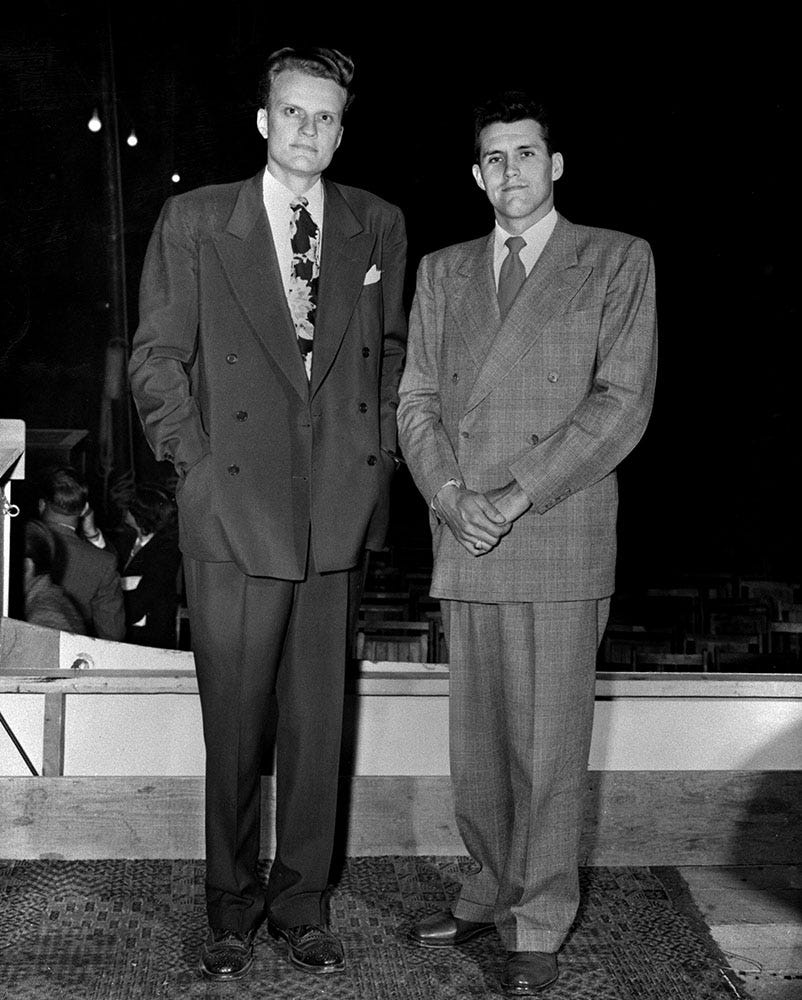
But the late Dr Graham’s crusade – in the same year Bill Haley hit the charts and rock’n’roll really began – was not the first time God had sent Americans to transform Scotland’s religious experience; nor was it to be the last. And the cavernous Tent Hall -today converted into flats, its surroundings sandblasted into something less dark and satanic – was crucial to all of it.
The Tent Hall’s roots were, unsurprisingly in a tent, a canvas church and homeless shelter on nearby Glasgow Green, erected as a direct result of the 19th Century evangelical crusade which dwarfed Graham’s subsequent visit in both immediate impact and long term effect. Glasgow and Scotland in turn influenced enormously the man whose preaching arguably resonates today into the theology and right-wing politics of the Trumpian forces now running rampant in the USA.
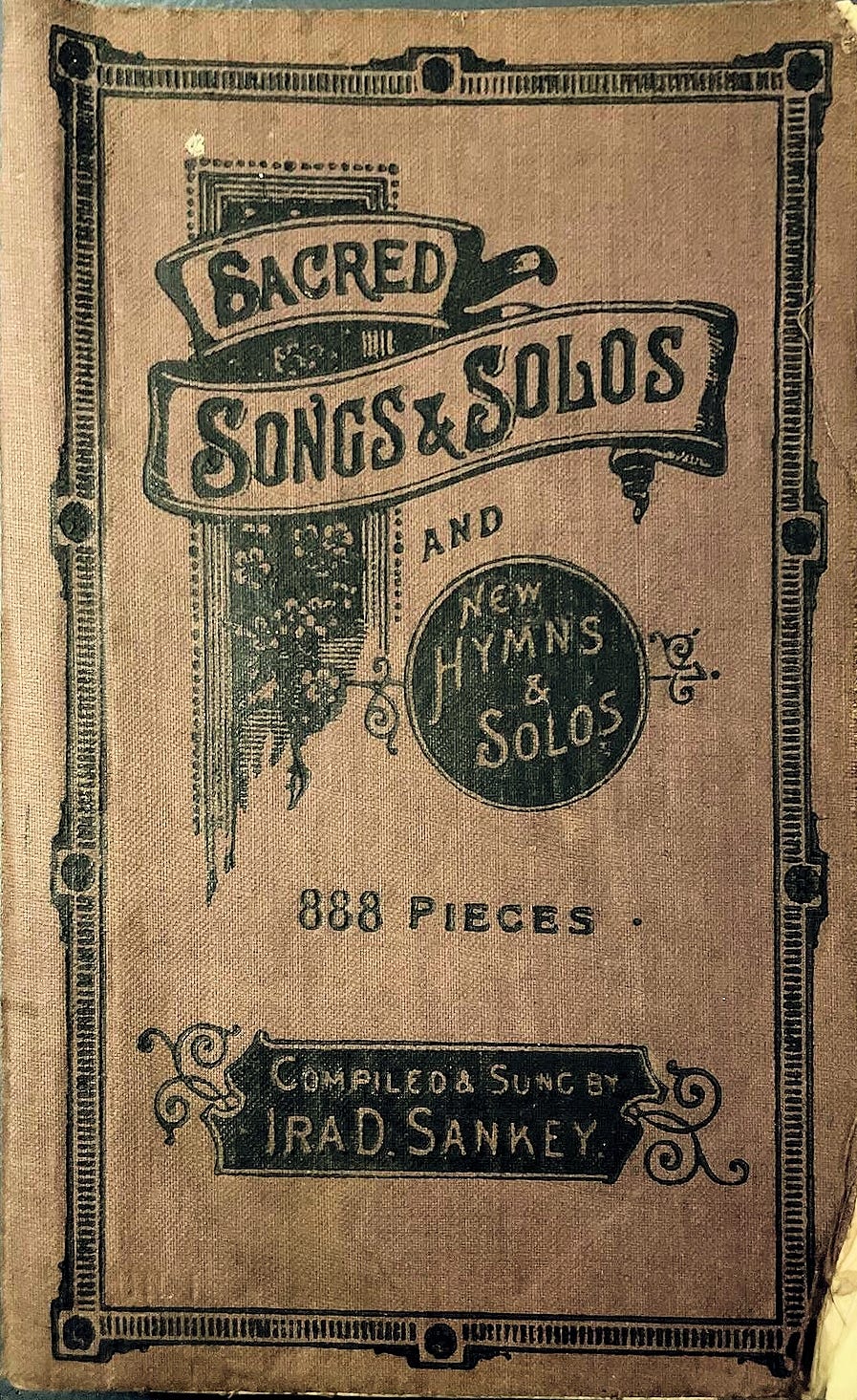
Dwight Lyman Moody (1837-99) was a Massachusetts farm boy and former shoe salesman who became the pre-eminent preacher of his generation. He had a musical sidekick, Ira David Sankey, singer, hymn writer, and song collector; the two of them compiled a hymn book called Sacred Songs and Solos which is still in use today, which became ubiquitous in the evangelical world, and whose tunes and lyrics influenced huge swathes of popular music, notably reggae. Sacred Songs and Sea Shanties, we used to affectionately sneer.
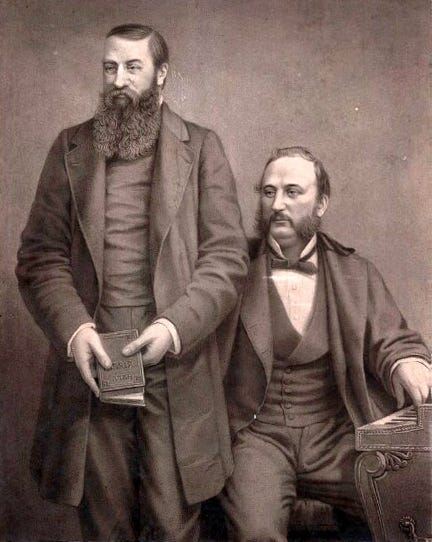
The pair arrived in Glasgow in 1874, and between February and April – without amplification – held huge rallies in the City Hall, on Glasgow Green and in the Kibble Palace in the Botanic Gardens. Over 3000 people ‘came to Christ’.
As a result, a group of local businessmen set up the Glasgow United Evangelistic Association, with its primary aim not so much winning more souls as feeding the poor and hungry. Regular breakfasts for the homeless began, and it was in this social action that the initial canvas kirk on Glasgow Green began, finally being transformed into stones and mortar on Steel Street. The GUEA, funded by Rutherglen chemical billionaire James White, ended up presiding over the gigantic Christian Institute in Bothwell Street, a gothic monstrosity which spawned the YMCA and the Bible Training Institute, and took up an entire city block.
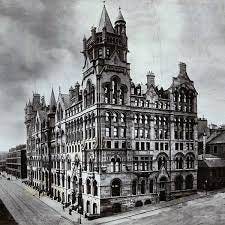
James White’s businesses polluted large tracts of land east of Glasgow, and he built a vast mansion high above Dumbarton called Overtoun House. In the early 1980s, I lived there as part of a Christian commune.
Moody and Sankey returned to Scotland several times – in 1883 and 1892. Their influence was colossal, and not just in Glasgow. In Edinburgh, their crusades led to the building of a city centre home for the Carubbers Close Mission (now the Carubbers Christian Centre). Rural Scotland’s churches were also influenced, and Moody himself was deeply affected by his stays during his visits to Scotland with Andrew Bonar, Free Church minister at Finnieston. In the book Mr Moody and the Evangelical Revival, Timothy George says that “Bonar’s union of scholarship zeal and devotion made a profound impact on Moody – and so did his success in Glasgow, his first major urban crusade. It showed that the evangelist was capable of stirring a large population. His first breakthrough to fame came not in the United States but in Glasgow. Moody was moulded by Britain as well as by America.”
Andrew Bonar, younger brother of the hymn writer Horatius ( I Heard the Voice of Jesus Say, and many others), was an unusual man within the Free Church – a Calvinist but a committed pre-millennialist, a believer that Christ was going to pluck all believers from the earth to ‘a meeting in the air’, magically removing them to heaven before his own ‘second coming’ to earth. The rapture, as it’s known. Moody had already been influenced by John Nelson Darby, (1800-82) one of the founders of the movement known as the Plymouth Brethren, in this direction, though Moody’s theology remained curiously simplistic, and if not entirely ecumenical, able to cross denominational barriers. But that pre-millennial eschatology would influence tens of thousands of other preachers across America, and is at the root of the right-wing extreme fundamentalism which provides much of the core Trump religious support, and indeed underpinned some White House policymaking (domestically on abortion and internationally on the Middle East). It’s reckoned that 81 per cent of white American evangelicals voted for Trump – and Pence, whose Christianity has always been key to his political persona – in 2016. How they will vote in 2024 remains to be seen. God only knows.
The development of premillennialism in the context of post-civil War USA is socially understandable, if pernicious. Michael Gerson, former speechwriter to George W Bush, said it both justifies and accepts a pessimistic view of world events. Writing in The Atlantic, he said this:
“This general pessimism about the direction of society was reflected in a shift away from postmillennialism and toward premillennialism. In this view, the current age is tending not toward progress, but rather toward decadence and chaos under the influence of Satan. A new and better age will not be inaugurated until the Second Coming of Christ, who is the only one capable of cleaning up the mess. No amount of human effort can hasten that day, or ultimately save a doomed world. For this reason, social activism was deemed irrelevant to the most essential task: the work of preparing oneself, and helping others prepare, for final judgment.”
https://www.theatlantic.com/magazine/archive/2018/04/the-last-temptation/554066/
Ah, the tribulation. One strand of premillennialism identifies a seven-year period of chaos and calamity, warfare and crisis, after which Christ will pluck believers out of the morass to heaven. Everyone else will be left to suppurate in the knowledge that it’s too late. Only hell awaits. It’s this Larry Norman sang about, and which has spawned a mini-industry of books and films like Hal Lindsay’s The Late Great Planet Earth and the horrendous 2014 movie Left Behind (starring, presumably for fiscal reasons, the great Nicolas Cage), based on the 1995 series of books by Tim La Hayeand Jerry B Jenkins.
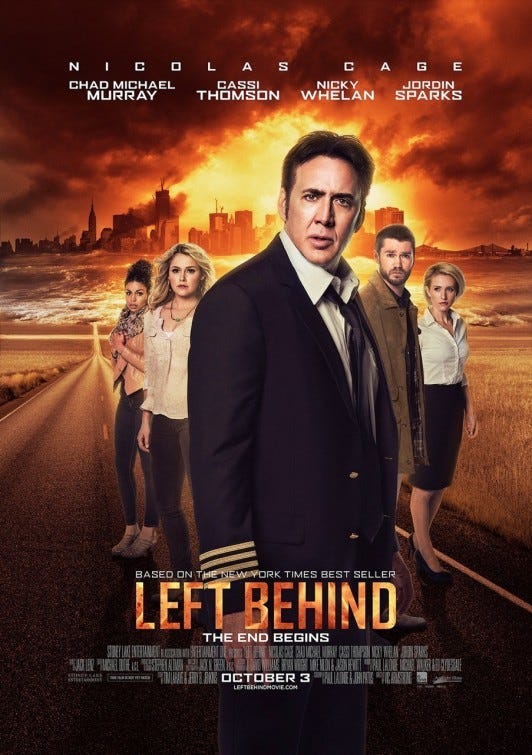
This magical beam-me-up-God scenario is taken very seriously in some quarters. You can buy Rapture insurance in the USA so that if, say, you’re flying an airliner or driving a bus when God ‘takes you home’, the repercussions of your departure are covered, at least financially. And of course, the exact time frame of these events has been a matter of – sometimes convenient, often embarrassing – conjecture. High profile Christian ‘numerologist’ David Meades has confidently claimed that the world would end, according to the book of Isaiah, on several occasions. He has been wrong every time. So far. http://www.patheos.com/blogs/progressivesecularhumanist/2018/04/get-ready-for-jesus-the-rapture-is-april-23/
This is fundamentalism run riot, a reading of Biblical text in literal, if not utterly banal terms. You will find people in on the extreme fundamentalist wings of both Messianic Judaism and Evangelical Christianity who are pursuing the breeding of pure red cattle in Israel, so that – to fulfil a prophecy found in the book of Numbers – a red heifer ‘without spot’ and born in Israel can be sacrificed and thus pave the way for the building of a Third Temple in Jerusalem. Speeding the arrival (or return) of the Messiah. This is treated comedically in Michael Chabon’s novel The Yiddish Policemen’s Union. But make no mistake, there were and are people in Donald Trump’s circle, who think that breeding red cows to speed up the End Times is a valid component of USA foreign policy. According to The Seattle Times, “Trump has made clear that he is listening to a powerful group of people eager to set the stage for Armageddon and the Second Coming. Their agenda, at least in terms of key aspects of his foreign policy, has become his.” Trump’s announcement that he would recognise Jerusalem as Israel’s capital is a result of this.
http://theconversation.com/why-trumps-evangelical-supporters-welcome-his-move-on-jerusalem-88775
According to Pastor Paula White, one of 40 evangelical leaders who publicly prayed over Trump for his electoral success, Evangelicals were “ecstatic, for Israel is to us a sacred place and the Jewish people are our dearest friends,” “The Jewish people have dedicated themselves to Jerusalem over millennia, taken pride in it, defended it with blood and treasure, and today we rejoice with them.”
*** *** ***
That night in 1972, I listened, paralysed, as Larry Norman sang his chilling song about the Rapture, I Wish We’d all Been Ready
A man and wife asleep in bed
She hears a noise and turns her head
He’s gone
I wish we’d all been ready
There’s no time to change your mind
The son has come
And you’ve been left behind…
Fear. A visceral, elemental fear of separation from loved ones. But we were ready. We were saved. We were OK. All that mattered was that other people were saved too. Politics, the environment, the future of our planet. None of that mattered, because soon, we’d all be with the Lord.
And yet, and yet: Dwight Moody was a pioneer campaigner for social justice who supported many projects aimed at helping the poor. Both Carubbers Close and the Tent Hall ran essential services for the homeless. Christ would be taking believers away and abandoning the world to its woes, but maybe….not quite yet.
*** *** ***
Larry Norman, who died in 2008, became a worldwide star, and he was, if not better than all the other Christian guitar pluckers and bellowers, at least genuinely American. He was strange, he was from Over There. He possessed a kind of implacable charisma, and he was a combination in vocal terms of Neil Young and Bob Dylan. In retrospect, his album Only Visiting this Planet was the first properly recorded (at Abbey Road in London) Christian rock record, and stands up now as derivative, banal, occasionally ridiculous but still confident, forceful, and sonically convincing. He meant it, man.
A biography by Gregory Thornbury is called Why Should the Devil Have All the Good Music? Larry Norman and the Perils of Christian Rock.
https://www.amazon.co.uk/Should-Devil-Have-Good-Music-ebook/dp/B01NBQ4NFP
It’s short, readable and seemingly based almost entirely on what the Norman family allowed Thornbury – an American academic – to see of Norman’s voluminous, often peculiar correspondence. Thornbury does his best to avoid prurience, though that’s impossible, given what is now publicly known about Norman’s complex and disturbing personal and business life. And the existence of a previous no-holds-barred, very controversial biopic called Fallen Angel: the Outlaw Larry Norman.
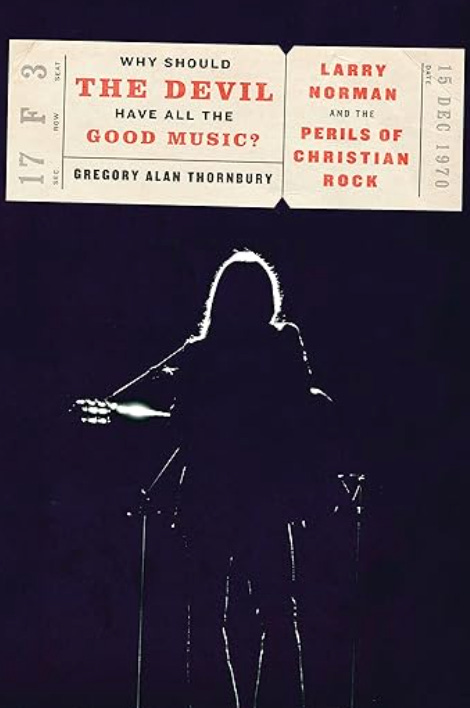
There’s Pamela, Norman’s ex-model wife, accused in the book of what to the puzzled observer looks like completely unthinking drug abuse, sexual amorality and theft. There are the interminable battles with Norman’s former protegé and friend Randy Stonehill, still a major figure on the multi-million dollar CCM (Contemporary Christian Music) scene whose reputation is coldly shredded by this book. Thornbury it seems, either couldn’t bring himself or wasn’t permitted by his deal with the Norman family to talk to either of them.
Larry Norman was a singer-songwriter. A star. A Christian prophet, priest, king. But with proverbial feet of clay. He was evidently a very difficult, self-obsessed and vain, egocentric man, from a strange religious and then briefly successful 60s pop showbusiness background. He was funny and brilliant and narcissistic and selfish, charming and vindictive, brutal and self-serving. His theology remained at nursery-rhyme level despite his much-vaunted intellectualism and continual referencing of GK Chesterton, that brilliantly funny writer and virulent anti-semite. He was a pioneer of the ‘Jesus Movement’, the post hippy phenomenon which took acid comedown into the world of protestantism (or arguably, saw evangelical protestantism harness the fallout from the summer of love for its own long-term objectives). He had long white hair.
And he’s dead, courtesy of congestive heart failure that in the end saw him fragile and failing among family in Salem, Oregon, and – in one of those curious rock’n’roll collisions which delight obsessive compulsive music fans such as myself – ended up in the same therapeutic bowling team as that perhaps even stranger and even more disturbed genius of ‘American Primitive’ guitar, John Fahey, who was also dying of heart failure. Did they talk about Blind Joe Death, Skip James and Robert Johnson selling his soul to the devil? I’d like to think so.
Thornbury’s biography is deeply flawed, hamstrung by the Norman family’s control over access to the singer’s archives, and a failure to talk to eyewitnesses, friends, enemies and observers. Norman too, was flawed. He was, like Moody 150 years ago, contradictory – involved in charitable and political campaigning while his apocalyptic pronouncements denied the validity of any such activity. But as we’ve seen, that daft premillennialism can, did and does walk hand in hand with a kind of shamed, human awareness that Jesus really did care for the poor, and wanted his followers to do the same.
In the end, Larry Norman was all too human, with sad stories of an unacknowledged child in Australia. Yet the last gigs continued, the songs remained the same. He kept singing them. He was big in Belfast.
He leaves behind a multi-billion dollar Christian music industry, and played his part in the spiritual rebirth of Mike Pence, oncefundamentalist power behind the Trump golf swing, and then instrumental in his (possibly temporary) downfall. The man who said this: “For me, it all begins with faith; it begins with what matters most, and I try and put what I believe to be moral truth first. My philosophy of government second. And my politics third.”
Norman’s songs helped establish the popularity of a lurid, horror-film theology, personified Left Behind books and that horrendous film: apocalyptic, stupid Christian melodramas which have infected political discourse in the USA, and which remain crucial to maintaining The Donald’s electoral constutuency. To be re-elected in 2024 he needs the support of people who believe the world is ending and the rapture may by imminent. In an eschatology which permits the prospect of global warfare as a precursor to eternal life for the born again.
So shall we sing, as Larry told us that night in the Tent Hall 46 years ago, That Sweet Sweet Song of Salvation?
When you know a pretty story, you don’t let it go unsaid,
You tell it to your children as you tuck them in the bed.
Shall we scare the living daylights out of them with fearsome stories of the tribulations and the rapture, and being left behind? Especially when quoting First Corinthians chapter 15, verse 52, in the King James Version:
“In a moment, in the twinkling of an eye, at the last trump: for the trumpet shall sound, and the dead shall be raised incorruptible, and we shall be changed.”
At the last: Trump. The Second Coming?.
Beatcrofting, the show. Listen here
https://www.mixcloud.com/tom-morton2/beatcrofting-with-tom-morton-friday-6-october/
Boo Hewerdine— Bell, Book and Candle
Free — Easy on My Soul
Bruce Cockburn — Mama Just Wants to Barrelhouse All Night Long
John Douglas — Leave Me Alone
The Kinks — Celluloid Heroes
Fairport Convention — Fotheringay
Joe Strummer — coma Girl
Graham Parker — Get Started, Start a Fire
Joni Mitchell — Come In From the Cold
Bon Iver — 8 (Circle)
Warren Zevon — Roland the Hadless Thompson Gunner
Kurt Vile — Life Like This

Leave a comment