

A long stay in Glasgow, the Covid comeback that began it finally receding. It’s the curse that keeps on giving, this plague, isn’t it? Malevolent in its ever-changing variety of symptoms, this time including desperate wheezing and excruciating toothache, every morning a different molar. Inhaling Sensodyne didn’t help. And no free jags for pensioners under 75 this year. I might play the heart disease card when I get home, or trust in Lagavulin 16 (or possibly Clynelish 14, which is a bargain currently).
Och, anyway, the truth is I’m on my own in the Dear Greeny-Golden-Brown place as I got the date for the Gillian Welch Theatre Royal gig wrong (29 OCTOBER, aged idiot!) and there were no beds left on the Shetland boat until Tuesday. This is due to that annual autumnal plain’n’purl extravaganza, Wool Week, when hundreds of needle-brandishing souls gather from across the world in Shetland to Celebrate the Fur of Sheep.
Compensations abound via weans and grandweans, though: A whole Friday responsible for Lily (Elves and Faery Day at Greenbank Gardens, courtesy of the National Trust, lunch and fairground rides at Rouken Glen). Watching Evie dismantle custard creams to her satisfaction. Fish and chips in Linlithgow with Charlie and Rosie.

And a too-long-away trip to the Wild West End for lunch with my daughter at the new and very good Corner Shop tapas joint behind the Kelvin Hall. Best tatties in town and at last, the return of a decent sherry selection in Glasgow. A fine Fino with anchovies. Bargain £27 lunch with a glass of house white.
Autumn in Glasgow’s west end is where I came in. Freshers Week, 1973. I came up from Ayrshire with a Framus guitar and my dad’s old RAF greatcoat, complete with illegal buttons. You were still liable to get stopped on the street by veterans who’d complain that they hadn’t fought Hitler so young louts could besmirch the uniform.
But it’s 2025, and Uniqlo Freshers flutter down Byres Road and through Kelvingrove Park, their futures shimmering on the surface of the Kelvin in the autumn sunshine. It seems idyllic. But I know that come the winter spates, the river will as ever surge yellow and fierce down to the Clyde, its force releasing the decades of chemical pollution on its bed and banks. The students, huddled and shivering, will sniff that sour stink and wonder if the future’s ever going to arrive. If it’s worth it.

There’s a refuge, though. A sanctuary, free and forever offering glimpses, rumours of glory. Not a church, not a bar, not the QM or GUU (forever the Men’s Union, never cool) or some rented tomb of a flat, shuddering in the cold. Kelvingrove Art Gallery and Museum, THE Art Gallery, a sprawl of red sandstone you can escape into for hours, days, months. Years.
When I was at university I was forever seeking places to hide, ways of calming the fears, frustrations, failures and terrors of student life. There was food, curries mostly. Very little drink in those days. Music, courtesy of Listen Records, 23rd Precinct, West End Records, Gloria’s in Battlesfield and Lost Chord over at Kinning Park. Cheap gigs at the Apollo. Second-hand books at Voltaire and Rousseau. Cinema, especially the Salon in Vinicombe Street, with its continuous showings you could wallow in all day, and free coffee in the balcony. And the Art Gallery.
In the early seventies it was a massive municipal clutter of stuff, and the ‘museum; aspect wasn’t of particular interest to me. Stuffed animals and armour. My specialist interests in old artefacts were dealt with over at the People’s Palace (now shamefully shut) and the Transport Museum, now a victim of Curation Syndrome, ransacked, reduced and overshadowed by the building housing the collection, the Riverside Museum down by the Clyde. In a way the Burrell building never does.
Kelvingrove, despite the vastly stucco-ed and chandeliered golden grandiosity of its main hall was tatty, then, and there was a randomness to the displays. After a while, though, tramping up and down its staircases and through its sometimes mysterious galleries, you – I – became seduced by its wonders. And for many it started with the Dali.

Christ of St John of the Cross is perhaps Glasgow’s most famous treasure, and I can still remember the first time I saw it. Back then you turned a corner and the painting was at the end of a corridor maybe 150 metres long. And it shone. It beamed at you, it reached out and drew you like a magnet. As you approached you realised how massive it was, and close up it was overwhelming. Dali’s version of St John of the Cross’s crucifixion vision is painted to dominate, and while some like to sneer at its chocolate box clarity, it has moved tens of thousands of cynical Glaswegians to tears. It’s power is undimmed.
Now it has its own shrine and it is curated and explained to within an inch of its life. Like so much else in the museum, there’s just too much faffing about with patronising captions, fussy and often pompous, maundering explanation.
And stuff that really shouldn’t be there at all. That bloody Spitfire. The horrible Elvis. The pathetic and tiny ‘Glasgow’ exhibition which is really a throwaway insult to the memory of the People’s Palace in its Elspeth King pomp.

And yet there are such glories. The Scottish Colourists are here in their humble splendour, the Peploes and Cadells and Fergussons, but the the scale of the French Impressionist collection is staggering, and in place mainly thanks to the wisdom, insight, charm and ruthless dealership skills of Dr Tom Honeyman, who from 1939 onwards, as director of the gallery, acquired probably the best collection of impressionist (plus pre-, pre-pre-, post- and post-post-) art outside London. He convinced Sir William Burrell to gift his collection to the city, too. co-founded the Citizen’s Theatre and the Scottish Arts Council, and all this after sterling service as a doctor in the First World War and in Glasgow’s East End.
So you have Degas, Van Gogh, Seurat, Monet, Pisarro…and they’re kind of left even today to make their own impression (sorry!), rather than being talked up by fusspot interpreters hooked on video and readying their AI armouries.

There’s much else, of course. The big Rembrandt, A Man in Armour is wonderful but it’s here that clever curation actually brings some benefit. Because next to it Frank Auerbach’s absolutely astonishing Head of EOW from 1955 has been hung, pointing up Rembrandt’s influence. Particularly that of his late slew of self-portraits, which includes one of my favourite paintings, the unforgiving masterpiece affectionately as Sid James, that sits craiggily in Edinburgh’s National Gallery. When I worked for The Scotsman, and lunchtime drinking was compulsory, I used to occasionally stumble out of Cafe Royal or the Halfway House and spend a sozzled few minutes gazing at that warts-and-all picture of dissolution. Now I just need to look in the mirror…
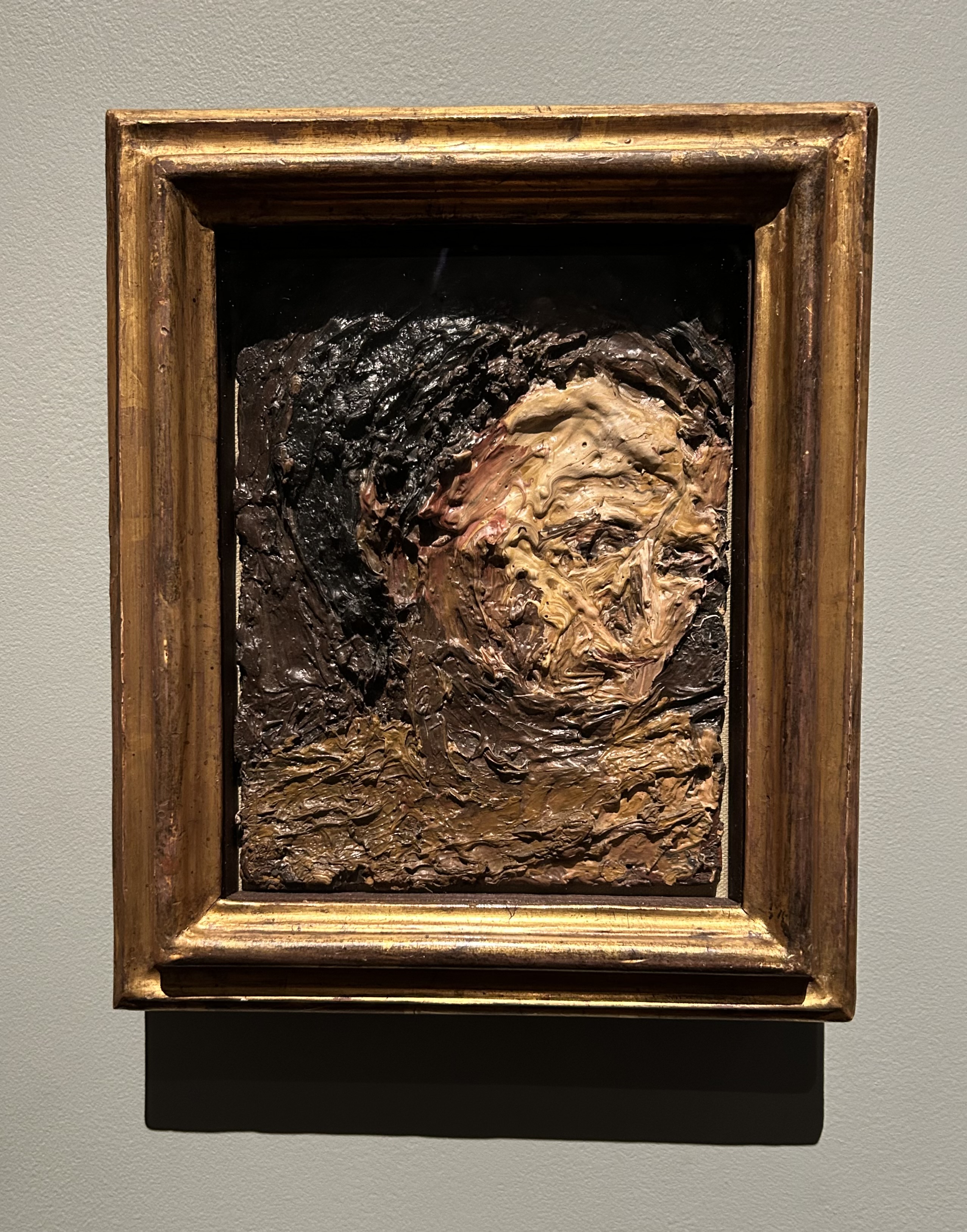
There’s still so much to love at Kelvingrove, once you get past the turgid thematic nonsense. It remains a sanctuary, a place of renewal and inspiration, and it will in the coming term be somewhere students can dog lectures, conduct romantic liaisons, pretend they’re working or just stay out of the weather for a while.
It seemed appropriate for me and Martha to catch a bus along Sauchiehall Street to Assai Records and browse (but not buy) vinyl. And then spend a couple of hours watching Spinal Tap II: The End Continues in the old-fashioned flip-seat darkness of the Glasgow Film Theatre. Where I once spent three consecutive evenings watching Leone’s Fistful of Dollars trilogy.
Did I do any academic work at all during my four years at Glasgow University? Apart from desperately photocopying pages from the Encyclopedia of Philosophy and recycling old Sixth Year Studies essays about King Lear?
Well. To a degree…


Leave a comment