
As fears grow over the risk to our islands’ from loaded tankers sailing too close to shore, the first time an oil tanker nearly came to grief on Shetland was in 1920.
Twenty-eight years ago Shetland was reeling in the aftermath of the Braer wreck. Those of us who were in the South Mainland during and immediately after the grounding will never forget the sluggish black movement of the waves as heavy bunker fuel brought thousands of dead fish and birds ashore; the sight of old Atlantic Airways Dakota DC-3s swooping absurdly low over the spilled oil amid clouds of useless dispersant; despairing suggestions that the RAF be brought in with incendiary bombs to burn away all pollution. And then the hurricane which scoured away most, if not all of the mess.
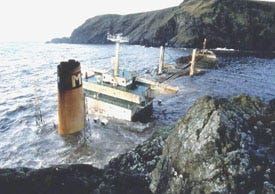
Shetland had suffered before, most notably when the tanker Esso Bernicia collided with a jetty at the Sullom Voe oil terminal in 1978, spilling 1174 tonnes of heavy fuel oil and causing major environmental damage. Now there is genuine concern that fully loaded tankers are flirting with disaster around Shetland’s sensitive and largely unspoilt coast – possibly just for the sake of a good mobile phone signal, or dawdling until the oil price rises. The BBC’s Jen Stout has written a report on what’s happening, and you can read that here.
The first encounter the isles had with an oil tanker in trouble was several decades earlier – and the islands, not to mention the ship concerned, were saved from disaster by the bravery of a few Whalsay fishermen in an open boat.
I’m grateful to that legend of the Shetland Times letters pages Jeremy Godwin for sending me this excerpt from The Orcadian of Thursday, 6 January 1921.
“On Monday last week the tug Ceto (Ross, Master) arrived at Lerwick from Stromness and proceeded the same day to Mid Yell. On the following day she took the Marion Chilcott in tow, and the vessels were about 11 miles south east of Fetlar, but they were then far enough out for the Marion Chilcott to proceed without assistance. The tug returned to Lerwick the same evening and after taking a supply of fresh water proceeded to Stromness. The tug is employed lifting the ships sunk in Hoy Sound to block the entrance to Scapa Flow. The Marion Chilcott, an American vessel, was gallantly saved from loss by Fetlar (not the case; they were from Whalsay) men during a gale in November, and brought to a place of safety at Yell.”
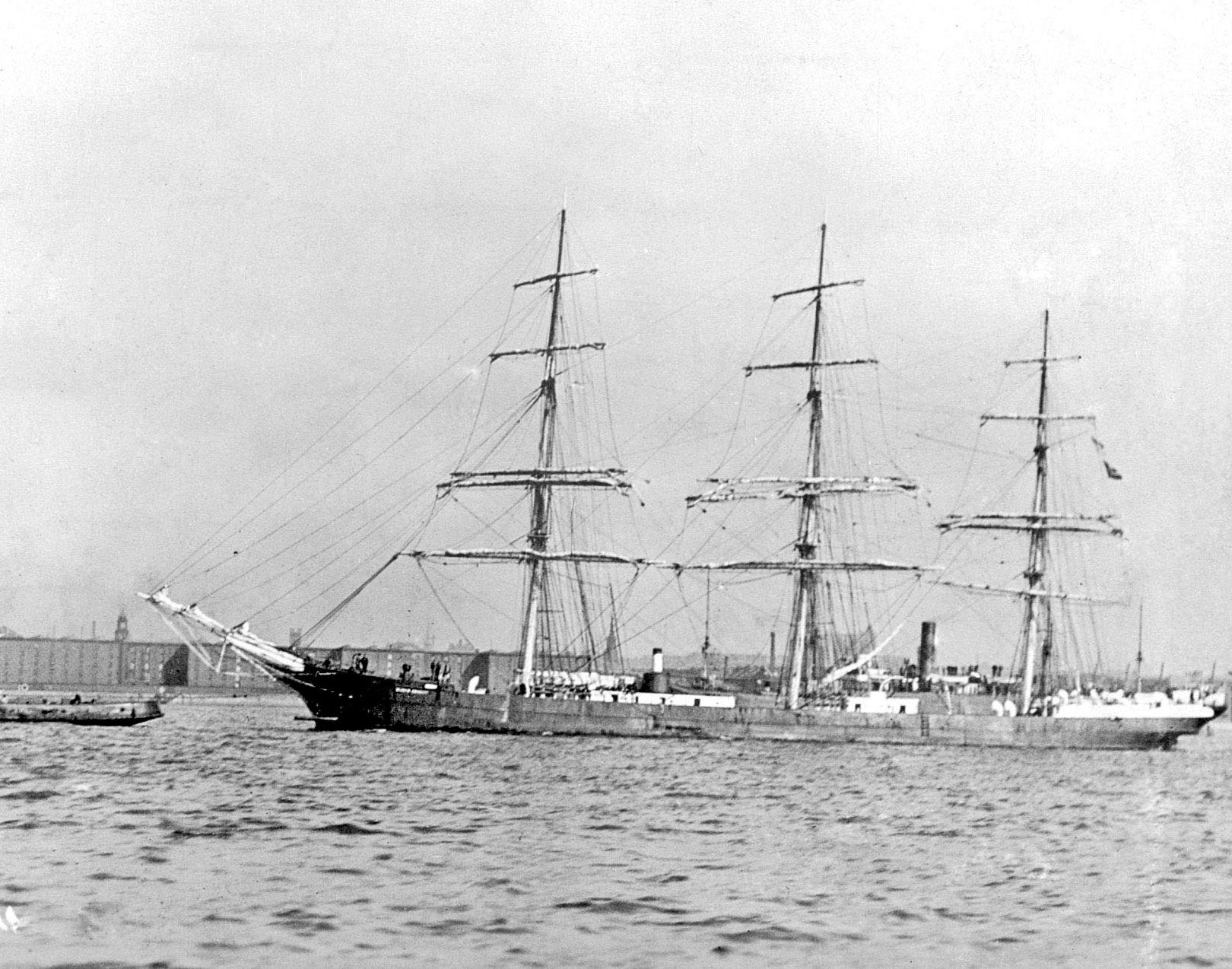
There are several extraordinary things about this story. But most notable perhaps is this: The Marion Chilcott was an oil tanker, capable of carrying 17,000 tons of fuel oil in her 12 tanks. But she was a sailing ship – a three-masted, full-rigged, iron-hulled vessel originally launched in 1882 as the Kilbrannan by Russell and Co at Port Glasgow, ordered by Kerr, Newton and Co. of Glasgow. She was 248 feet long, with a beam of 38 feet, and originally a depth of hold of 22 feet and nine inches. Six metres longer than HMS Victory and 10 shorter than the Cutty Sark.
Converted from a general cargo ship in 1902 (“we could have half a dozen holes in the bottom of this ship and it would still float” said her proud captain immediately afterwards) the Marion Chilcott changed hands several times and in November 1920, owned by the Californian shipping company GW McNear and US-registered, she was on her way from Denmark to St Thomas in the West Indies, almost certainly carrying fuel oil or petrol.
According to the RNLI’s Lifeboat Magazine of February 1922:
“She was a few days out she met with very thick weather and strong south-easterly gales. She was driven down onto the Shetland Isles, and on the morning of 1 December found herself being swept along by the current from the Skerries past Fetlar and in the direction of Yell. She was then unmanageable and in grave danger of being carried on to the numerous rocks.”
It’s hard to imagine the danger she, her crew and anyone nearby was in: A floating, powerless bomb, utterly at the mercy of wind and tide.
“The captain dropped his anchor, but the cable parted owing to the heavy sea. He then lowered a life-boat in readiness to embark the crew in the event of total shipwreck, but the boat was washed away and smashed to pieces.”
What happened next remains one of Shetland’s greatest sea-rescues, and one undertaken against almost unthinkable odds.
“The perilous position of the ship had been seen by five fishermen of Scaw (on the island of Whalsay), John Bruce, Laurence Bruce, Hugh Bruce, Laurence Hutchison, and William Irvine. They launched their sailing boat, a small boat only 15 feet long, in light ballast, hoisting as much sail as could be carried in order to get clear of the rocks. Once clear, they had to take in two reefs, and could scarcely carry their sail under these conditions. With considerable difficulty they reached the Marion Chilcott, and, despite the heavy sea, Laurence Bruce and William Irvine succeeded in boarding her at great risk to themselves. They took charge, and succeeded in piloting the vessel safely into Bluemull Sound. In doing so they unquestionably saved not only the vessel, but the lives of the captain, his wife, and crew of 26. Meanwhile a small motor boat, the Fern, with a crew of six men, had set out to the rescue, but by the time they arrived the danger was past. Their services were used only for towing the small boat into harbour.”
Laurence Bruce and William Irvine “took charge”. You can imagine the scene on the Marion Chilcott’s bridge, and the relief when she reached safety. The RNLI awarded each of the five men who went out under sail the charity’s Bronze Medal and “a monetary reward”; the six men who went out aboard the Fern received some cash. The United States Government awarded gold medals to the five Whalsay men too.
All of this perhaps highlights the risks oil tankers pose to the Shetland coastline, and to themselves, right from the beginning of hydrocarbon transportation at sea. And at a time when once more, there is great concern about the close-to-shoreline routes taken by some crude carriers bound for or leaving Sullom Voe, and the “parking” of loaded vessels while cargo owners wait for the oil price to shift, perhaps it is worth remembering the song written by Ralph McTell and the late Maartin (sic) Allcock about the Braer, called The Islands. It can be heard via YouTube, here:
performed by Fairport Convention.
Oh, let this be a warning
To those whose faceless greed
Would sail close to the shoreline
To save both fuel and speed
The sea is our protector
Provider of our needs
A jealous guard and keeper
Of the islands.
The Marion Chilcott was eventually dismasted and used as a floating oil storage hulk, until she was scrapped in 1953.
A version of this story first appeared in The Shetland Times


Leave a comment